Currency ETFs Simplify Trading
Investing in any market can be volatile. Minimizing risk while retaining upside potential is paramount for most investors - that's why an increasing number of traders and investors are diversifying and hedging with currencies. Different currencies benefit from some of the same things that may hurt stock indexes, bonds or commodities and can be a great way to diversify a portfolio. However, digging into currencies as a trader or investor can be daunting.
New currency exchange-traded funds (ETFs) make it simpler to understand the forex market (the largest, most liquid market on the planet), and use it to diversify risk.
Now, you can have General Electric (NYSE:GE) and the British pound in your portfolio by holding the CurrencyShares British Pound ETF (PSE:FXB) in the same account. Have an IRA? Sprinkle some euros in there by holding the CurrencyShares Euro ETF (PSE:FXE), and offset some downside risk of your S&P 500 holdings. Read on to learn more about this unique way of using currencies to diversify your holdings.
Hedging Against Risk
Every investor is exposed to two types of risk: idiosyncratic risk and systemic risk. Idiosyncratic risk is the risk that an individual stock's price will fall, causing you to accumulate massive losses on that stock. Rooting this kind of risk out of your portfolio is quite simple. All you have to do is diversify your account across a broad range of stocks or stock-based ETFs, thus reducing your exposure to a particular stock.
However, diversifying across a broad range of stocks only addresses idiosyncratic risk. You still have to face your account's systemic risk.
Systemic risk is the exposure you have to the entire stock market falling, causing you to accumulate losses across your entire diversified portfolio. Minimizing the exposure of your portfolio to a bear market used to be difficult. You had to open a futures account or a forex account and try to manage both it and your stock accounts at the same time. While opening a forex account and trading it can be extremely profitable if you apply yourself, many investors aren't ready to take that step. Instead, they decide to leave all of their eggs in their stock market basket and hope the bulls win. Don't let that be you.
Currency ETFs are opening doors for investors to diversify. You can now easily mitigate systematic risk in your account and take advantage of large macroeconomic trends around the world by putting your money not only into the stock market but also in the forex market through these funds. (For more see, A Beginner's Guide To Hedging.)
How Currency ETFs Work
ETF management firms buy and hold currencies in a fund. They then sell shares of that fund to the public. You can buy and sell ETF shares just like you buy and sell stock shares. Investors value the shares of the ETF at 100 times the current exchange rate for the currency being held. For example, let's assume that the CurrencyShares Euro Trust (PSE:FXE) is currently priced at $136.80 per share because the underlying exchange rate for the euro versus the U.S. dollar (EUR/USD) is 1.3680 (1.3680 × 100 = $136.80).
You can use ETFs to profit from the exchange rate of the dollar versus the euro, the British pound, the Canadian dollar, the Japanese yen, the Swiss franc, the Australian dollar and a few other major currencies. (For more on this market, see Common Questions About Currency Trading.)
What makes currencies move?
Unlike the stock market, which has a long-term propensity to rise in value, currencies will often channel in the very long term. Stocks are driven by economic and business growth and tend to trend. Conversely, inflation and issues around monetary policy may prevent a currency from growing in value indefinitely.
Currency pairs may trend as well, and there are simple factors that influence their value and movement. These factors include interest rates, stock market yields, economic growth and government policy. Most of these can be forecasted and used to guide traders as they hedge risk in the rest of the market and make profits in the forex.
Economic Factors and Currency Trends
Here are two examples of economic factors and the currency trends they inspire.
- Oil and the Canadian Dollar
Each currency represents an individual economy. If an economy is a commodity producer and exporter, commodity prices will drive currency values. There are three major currencies that are known as "commodity" currencies that exhibit very strong correlations with oil, gold and other raw materials. The Canadian dollar (CAD) is one of these.
One ETF that can be traded to profit from the moves in the CAD/USD pair is CurrencyShares Canadian (PSE:FXC). Because the Canadian dollar is on the base side of this currency pair, it will pull the ETF up when oil prices are rising and it will fall when oil prices are declining. Of course, there are other factors at play in that currency's value but energy prices are a major influence, and can be surprisingly predictive of the trend.
This is especially useful for stock traders because of the effect that higher energy prices can have on stock values. Additionally, it provides another way for stock traders to speculate on rising commodity prices without having to venture into the futures market.
In Figures 1 and 2, you can see 18 months of prices for the Canadian dollar compared to oil prices over the same period.
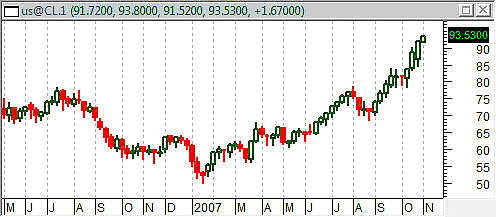 |
| Figure 1: Crude oil (continuous) |
| Source: MetaStock Pro FX |
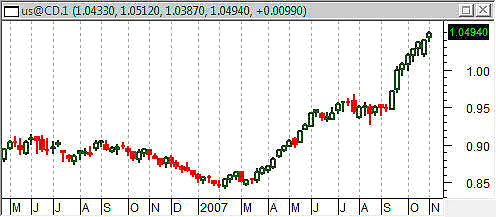 |
| Figure 2: Canadian dollar |
| Source: MetaStock Pro FX |
As you can see, there is a strong positive correlation between these two markets. This is helpful as a hedge against stock volatility as well as the real day-to-day costs of higher energy prices.
Short-term traders may look for a breakout in oil prices that is not reflected in the value of the Canadian dollar immediately. When these imbalances occur, there is opportunity to take advantage of the move the market will make as it "catches up" with oil.
Long-term traders can use this as a way to diversify their holdings and speculate on rising energy prices. It is also possible to short the ETF to take advantage of falling oil prices.
2. Interest Rates and the Swiss Franc
There are several forex relationships that are impacted by interest rates, but a dramatic correlation exists between bond yields and the Swiss franc. One ETF that can be used to profit from the Swiss franc, or "Swissie", is the CurrencyShares Swiss Franc Trust (PSE:FXF). The currency pair is notated as CHF/USD. When the Swissie is rising in value, the ETF rises as well, as it costs more U.S. dollars to buy a Swiss franc.
The correlation described here involves the 10-year bond yield. You will notice in Figures 3 and 4 that when bond yields are rising, the Swissie falls, and vice versa. Depending on interest rates, the value of the Swissie will frequently rise and fall with bond yields.
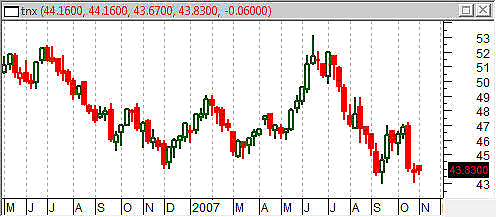 |
| Figure 3: 10-Year Bond Yields (TNX) |
| Source: MetaStock Pro FX |
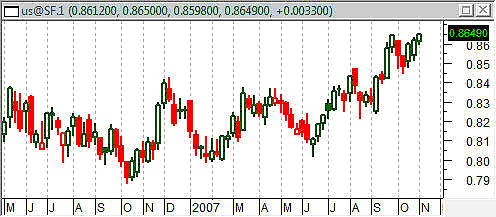 |
| Figure 4: Swiss franc |
| Source: MetaStock Pro FX |
This relationship is useful not only as a way to find new trading opportunities but as a hedge against falling stock prices. The stock market has a positive correlation with bond yields; therefore, if yields are falling, the stock market should be falling as well. A savvy investor who is long the Swissie ETF can offset some of those losses.
Conclusion
Currency ETFs have opened the forex market to investors focused on stocks. They adds an additional layer of diversification and can also be used effectively by shorter term traders for quick profits. There are even options available for most of these ETFs.
Getting Started in Currency Futures
The spot foreign exchange (forex or FX) market is the world's largest market, with over one trillion U.S. dollars traded per day. One derivative of this market is the forex futures market, which is only 1/100th the size. This article examines the key differences between forex futures and traditional futures and looks at some strategies for speculating and hedging with this useful derivative.
Forex Futures versus Traditional Futures
Both forex and traditional futures operate in the same basic manner: a contract is purchased to buy or sell a specific amount of an asset at a particular price on a predetermined date. (For an in-depth introduction to futures, see Futures Fundamentals.) There is, however, one key difference between the two: forex futures are not traded on a centralized exchange; rather, the deal flow is available through several different exchanges in the U.S. and abroad. The vast majority of forex futures are traded through the Chicago Mercantile Exchange (CME) and its partners (introducing brokers).
However, this is not to say that forex futures contracts are OTC per se; they are still bound to a designated 'size per contract,' and they are offered only in whole numbers (unlike forward contracts). It is important to remember that all currency futures quotes are made against the U.S. dollar, unlike the spot forex market.
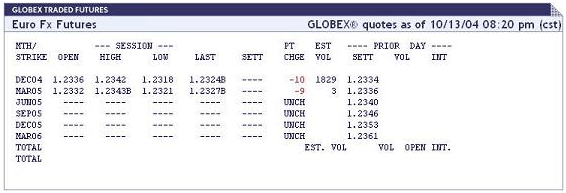
Here is an example of what a forex futures quote looks like:
Euro FX Futures on the CME
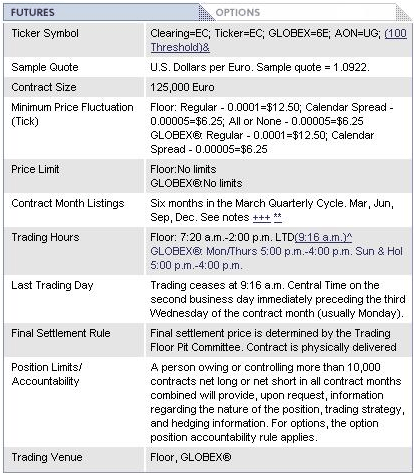
For any given futures contract, your broker should provide you with its specifications, such as the contract sizes, time increments, trading hours, pricing limits, and other relevant information. Here is an example of what a specification sheet might look like:
Specification Sheet from CMEHedging versus Speculating
Hedging and speculating are the two primary ways in which forex derivatives are used. Hedgers use forex futures to reduce or eliminate risk by insulating themselves against any future price movements. Speculators, on the other hand, want to incur risk in order to make a profit. Now, let's take a more in-depth look at these two strategies:Hedging
There are many reasons to use a hedging strategy in the forex futures market. One main purpose is to neutralize the effect of currency fluctuations on sales revenue. For example, if a business operating overseas wanted to know exactly how much revenue it will obtain (in U.S. dollars) from its European stores, it could purchase a futures contract in the amount of its projected net sales to eliminate currency fluctuations.When hedging, traders must often choose between futures and another derivative known as a forward. There are several differences between these two instruments, the most notable of which are these:
- Forwards allow the trader more flexibility in choosing contract sizes and setting dates. This allows you to tailor the contracts to your needs instead of using a set contract size (futures).
- The cash that's backing a forward is not due until the expiration of the contract, whereas the cash behind futures is calculated daily, and buyer and seller are held liable for daily cash settlements. By using futures, you have the ability to re-evaluate your position as often as you like. With forwards, you must wait until the contract expires.
Speculating
Speculating is by nature profit-driven. In the forex market, futures and spot forex are not all that different. So why exactly would you want to participate in the futures market instead of the spot market? Well, there are several arguments for and against trading in the futures market:Advantages
- Lower spreads (2-3).
- Lower transaction costs (as low as $5 per contract).
- More leverage (often $500+ per contract).
Disadvantages
- Often requires a higher amount of capital ($100,000 lots).
- Limited to the exchange's session times.
- NFA (National Futures Association) fees may apply.
The strategies employed for speculating are similar to those used in spot markets. The most widely used strategies are based on common forms of technical chart analysis since these markets tend to trend well. These include Fibonacci studies, Gann studies, pivot points, and other similar techniques. Alternately, some speculators use more advanced strategies, such as arbitrage.
Conclusion
As we can see, forex futures operate similarly to traditional stock and commodity futures. There are many advantages to using them for hedging as well as speculating. The distinguishing feature of forex futures is that they are not traded on a centralized exchange. Forex futures can be used to hedge against currency fluctuations, but some traders use these instruments in pursuit of profit, just as they would use futures on the spot market.


0 comments:
Post a Comment